
 Join
Join
6 Types of Nonmelanoma Skin Cancer


Key Takeaways
- Nonmelanoma skin cancers are grouped by the type of cell where they begin, and knowing the type can help a healthcare team decide which treatment options may work best. View all takeaways
Sign up for free to view the full article summary.
Continue with EmailNonmelanoma skin cancers are classified based on the type of cell where they start and how the cancer cells look under a microscope. Knowing a skin cancer’s type can help your healthcare team predict how the cancer may behave and which skin cancer treatments may work best.
Each type of nonmelanoma skin cancer has distinct features, such as what it looks like and how fast it develops. This article provides an overview of different nonmelanoma skin cancer types.
Basal Cell Carcinoma
Basal cell carcinoma (BCC) is the most common type of nonmelanoma skin cancer. It accounts for about 75 percent of all nonmelanoma skin cancer diagnoses.
Like other forms of skin cancer, BCC tends to appear in areas of skin that are frequently exposed to ultraviolet (UV) light from the sun or tanning beds, such as your head and neck.
Where It Originates
Basal cell carcinoma originates in your skin’s basal cells. These are cells in the deeper part of your epidermis (your skin’s surface layer). Basal cells continuously reproduce, pushing older cells to the surface where they’ll eventually shed.
What It Looks Like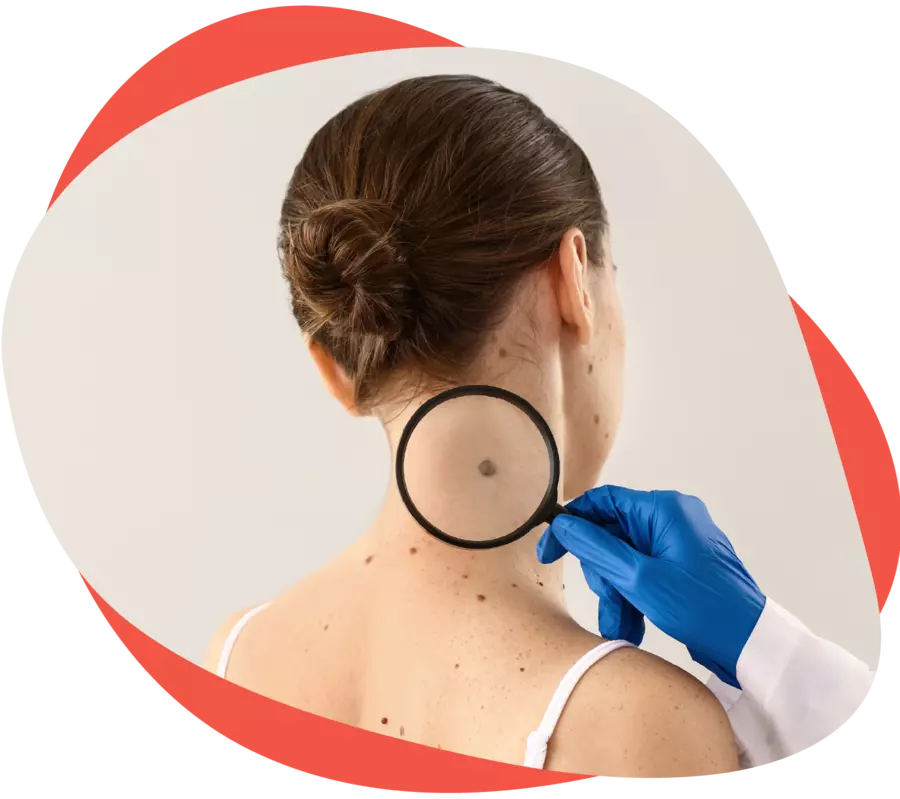
There are four main BCC subtypes, and they each tend to look a little different. Here are the most common features of each BCC subtype:
- Nodular BCC — This might look like a round nodule with a pimple-like appearance, often surrounded by small blood vessels.
- Superficial BCC — This appears as a scaly, discolored patch of skin.
- Sclerosing (morpheaform) BCC — This may look like scars that gradually expand or like tiny red or brown dots.
- Pigmented BCC — This looks like a shiny raised bump, ranging in color from light brown to dark black.
Remember that BCC will appear differently on various skin tones. Signs of BCC may look pink or red on lighter skin, but grayish, brown, blue-gray, or black on darker skin.
Some BCC lesions can bleed or ooze fluid when scratched or bumped. Your BCC may also feel tender, painful, or itchy.
Metastatic Risk
The metastatic risk describes the likelihood that a cancer will spread to areas other than the skin. BCC is highly unlikely to spread, but without the proper treatment, there is a small risk.
It’s worth noting that, while BCC usually doesn’t spread, having one BCC lesion increases your risk of developing another.
Squamous Cell Carcinoma
Squamous cell carcinoma (SCC) is also quite common, accounting for about 25 percent of all diagnosed nonmelanoma skin cancers. It tends to grow faster than BCC.
SCC tends to grow in areas of the body that get a lot of sunlight — most commonly on the arms, legs, and head. Chemical exposure (being around chemicals like arsenic or cigarette smoke) can also play a role in causing SCC.
Where It Originates
SCC and BCC both originate in the epidermis, but in different cell types. SCC originates in squamous cells, which are flattened cells at the surface of the epidermis. Squamous cells also line the insides of different organs, like your mouth and lungs.
What It Looks Like
SCC lesions often look like a scaly patch of skin. The skin may become rough or bumpy in texture, and it might scab or crust over. You might mistake it for a sore at first, but it doesn’t heal as a typical sore would.
SCC lesions appear dark brown or black on darker skin and red or pink on lighter skin. They may also be the same color as your natural skin tone.
SCC can appear as a painful bump with a divot in the middle, or it may be flat and at least an inch wide.
Metastatic Risk
SCC is more likely to spread than BCC, but it’s still rare, and the risk is low compared to melanoma. If it does spread, SCC may grow into deeper layers of skin.
Without treatment, SCC may eventually spread to nearby lymph nodes. Still, this is uncommon.
Less Common Nonmelanoma Skin Cancer Types
BCC and SCC make up the majority of nonmelanoma skin cancers, but there are a few rarer types. Some are linked to UV light exposure, which can damage the DNA in skin cells and lead to cancer.
Here are four more types you should know.
Merkel Cell Carcinoma
Merkel cell carcinoma (MCC) originates in Merkel cells, which are neuroendocrine cells in the skin. “Neuroendocrine” means they share features of both nerve cells and hormone-producing cells.
MCC is extremely rare, affecting just 3,000 people in the United States each year. But experts note that it may be more commonly diagnosed as people live longer and as diagnostic tests improve.
An MCC tumor typically appears on areas of skin with a lot of sun exposure. It looks like a pink, red, or purple, shiny or pearlescent lump on lighter skin, while the lump will appear dark brown, black, or blue on darker skin.
The lump can grow quickly and might feel tender or sore. This type of skin cancer is more aggressive than other nonmelanoma skin cancers. It can metastasize (spread) quickly to other body parts.
Cutaneous Lymphoma
Cutaneous lymphoma, or skin lymphoma, is a type of non-Hodgkin lymphoma that occurs in the skin. Lymphocytes, a type of white blood cell that works as part of the immune system, grow out of control in one of two different skin cell types: T cells or B cells. Cutaneous T-cell lymphoma is more common than cutaneous B-cell lymphoma, but both are rare.
On lighter skin, cutaneous T-cell lymphoma tends to look like a flat, red patch of skin that’s easily mistaken for eczema. It may even be itchy. On darker skin, the patch may appear brown, purplish, or gray.
Cutaneous B-cell lymphoma looks a little different, typically appearing as lumps on the skin. In both types, symptoms can appear in multiple places.
Sebaceous Gland Cancer
Sebaceous gland cancer, or sebaceous carcinoma, is a rare type of skin cancer that originates in your skin’s sebaceous glands. These glands produce natural oils that moisturize your skin and protect your body from germs like viruses and bacteria.
The most common place to develop sebaceous carcinoma is on the eyelid, though you can develop it almost anywhere on the skin. Like MCC, it can spread rapidly.
If a sebaceous gland tumor develops on your upper or lower eyelid, it can look similar to a pimple. It may bleed easily and cause crusting along your lash line.
Kaposi’s Sarcoma
Kaposi’s sarcoma is a type of soft tissue cancer that most often affects the skin, but it can also develop in other parts of the body. You’re more likely to develop it if you have HIV, but not everyone who gets Kaposi’s sarcoma has HIV. Anyone who has a weakened immune system is more susceptible.
Kaposi’s sarcoma is extremely rare, affecting less than 5,000 people in the United States. There are four different types, and some types are distinctive to specific regions in the world.
When Kaposi’s sarcoma affects the skin, its symptoms include unusual smooth or bumpy spots with possible pain or swelling. These spots will appear bluish, brown, or black on darker skin tones. On lighter skin tones, they often look red or purple.
 How Skin Cancer Type Affects Diagnosis and Treatment
Early detection and treatment are important for any type of nonmelanoma skin cancer to prevent it from spreading. It’s important to do regular skin checks and report any unusual lesions or skin changes to your dermatologist as soon as possible.
Wear sunscreen to protect your skin from UV rays, which can increase the risk for these cancer types.
A skin exam can help diagnose nonmelanoma skin cancer, but your dermatology team may also perform a skin biopsy to confirm which type of skin cancer you have. A skin biopsy involves removing some or all of the abnormal-looking skin so it can be examined under a microscope. Your doctor may also recommend a lymph node biopsy for skin cancers that spread quickly, like MCC.
Treating These Cancers
Your dermatologist will recommend the best skin cancer treatment options based on your skin cancer type, size, and location.
Surgery can often remove all of the cancer if it hasn’t spread yet. Your dermatologist might remove a margin of healthy skin around the unusual spot, too. They might remove the lesion using other strategies, like cryosurgery (freezing it off).
You may also need other cancer treatments to treat any cancer that can’t be removed completely with surgery. Radiation therapy, chemotherapy, or immunotherapy can all help kill cancer cells that have spread beyond the skin.
Join the Conversation
On MySkinCancerTeam, people share their experiences with skin cancer, get advice, and find support from others who understand.
Have you been diagnosed with a type of nonmelanoma skin cancer? Let others know in the comments below.
- Types of Non Melanoma Skin Cancer — Cancer Research UK
- Melanoma vs. Non-Melanoma Skin Cancer: Key Differences and Treatments — American Society for Mohs Surgery
- Basal Cell Carcinoma — Cleveland Clinic
- Metastasis (Metastatic Cancer) — Cleveland Clinic
- Squamous Cell Carcinoma — Cleveland Clinic
- Squamous Cell Skin Cancer — Penn State Health
- Non-Melanoma Skin Cancers: Biological and Clinical Features — International Journal of Molecular Sciences
- Merkel Cell Carcinoma — Cleveland Clinic
- Lymphocytes — Cleveland Clinic
- Sebaceous Carcinoma — Cleveland Clinic
- Kaposi Sarcoma — Cleveland Clinic
Related
- What does basal cell carcinoma look like? See answer
- What can I expect from Mohs surgery for skin cancer? See answer
- What causes skin cancer and what raises my risk? See answer
- What are common symptoms of skin cancer? See answer






 Your Privacy Choices