
 Join
Join
Basal Cell Carcinoma Stages: Pictures and Symptoms


Key Takeaways
- Basal cell carcinoma (BCC) is the most common type of skin cancer, and while it usually grows slowly, it can be hard to spot in its earliest stages when it may look like a pimple, scar, or dry skin patch. View all takeaways
Sign up for free to view the full article summary.
Continue with EmailBasal cell carcinoma (BCC) is the most common type of skin cancer. Fortunately, it usually grows slowly and is highly treatable, especially when found early. However, it can be hard to spot in its earliest stages.
Some early BCCs can look like harmless pimples, scars, or patches of dry skin. More advanced BCCs can be larger, more painful, and harder to treat.
Understanding the symptoms of BCC at different stages can help you recognize warning signs earlier and improve the chances of early detection and successful treatment. Although basal cell carcinoma is not usually assigned a formal stage because it rarely spreads, doctors may still describe it based on its size, depth, location, and high-risk features.
Stage 0 Basal Cell Carcinoma
Stage 0 BCC is the earliest stage. It’s also called carcinoma in situ. At this stage, abnormal cells are found only in the top layer of skin. They haven’t grown deeper or spread to nearby tissue.
This stage is less common than later stages because many BCCs go unnoticed until they begin to grow. Routine skin checks with a dermatologist can help identify early-stage BCC.
Basal cell carcinoma often goes unnoticed until it has started to advance. Routine skin checks with a dermatologist can help identify early-stage BCC.
What It Looks Like
Everyone’s skin is different. Only a dermatologist can tell if a mark on your skin is cancer.
Stage 0 BCC may appear as:
- A flat or slightly raised patch of skin
- An area that looks lighter, darker, pink, or red compared with the surrounding skin
- A rough or scaly spot
- A shiny patch that resembles eczema or irritation
- A small sore that repeatedly crusts or bleeds
Early lesions are usually painless and can be mistaken for minor skin irritation.
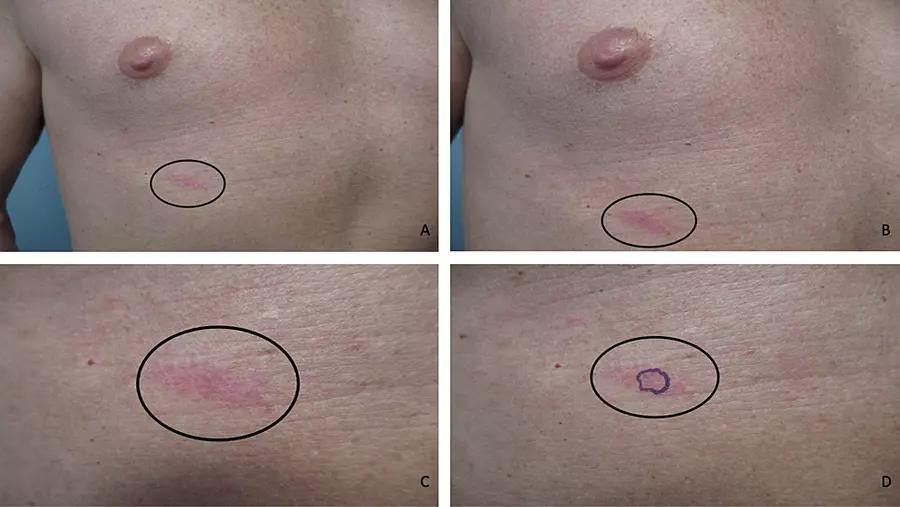
Stage 0 basal cell carcinoma may appear as a small patch of slightly discolored skin. (CC BY-SA 4.0/Cohen P.R.)
Where BCC Develops
BCC can develop anywhere on the body. It’s most common in areas that get regular sun exposure, such as the head, neck, arms, and hands. Ultraviolet light is a major risk factor for BCC.
Treatment Options
At this stage, treatment is usually very effective and often less invasive than treatment for advanced cancer.
Treatment options may depend partly on where the skin cancer is located. BCCs near the eyes, nose, or ears may require more careful planning. Treatment may include:
- Topical medications
- Cryotherapy (freezing off the tumor)
- Surgery
Stage 1 Basal Cell Carcinoma
Stage 1 BCC means the cancer has grown deeper into the skin, but it is considered an early stage. In general, the tumor is about 0.8 inches (2 centimeters) or smaller. It hasn’t spread to nearby lymph nodes or distant organs.
What It Looks Like
Stage 1 BCC may look like:
- A shiny bump with tiny blood vessels
- A flesh-colored, pink, or darker growth
- A sore that doesn’t heal
- A patch that bleeds repeatedly
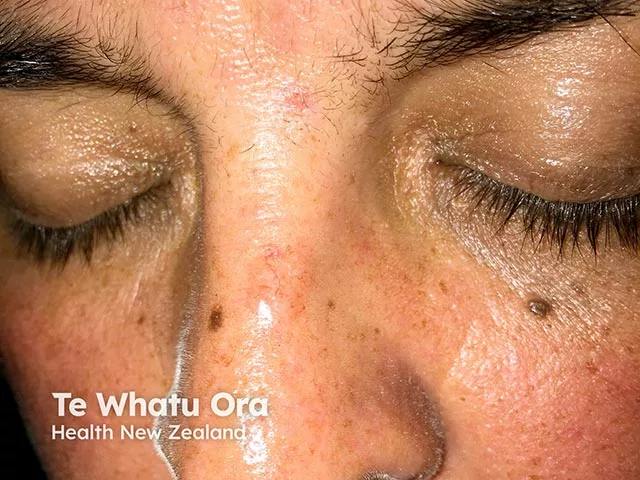
At stage 1, basal cell carcinoma may appear as a small bump or a sore that doesn’t heal. (CC BY-NC-ND 4.0/DermNet)
Some types of BCC can be mistaken for harmless skin conditions. Superficial BCC may look like eczema or psoriasis. Morpheaform BCC may look like a scar.
Nodular BCC, the most common subtype, often looks like a shiny pimple. In people with darker skin tones, BCC is more likely to appear as a dark brown or black nodule.
How It Feels
Symptoms of stage 1 BCC are often mild. Some people notice:
- Occasional itching
- Tenderness or pain
- Bleeding after minor trauma
Treatment Options
Stage 1 BCC is usually highly treatable. Early treatment can help prevent the cancer from growing larger or becoming more difficult to treat. Treatment options for BCC at this stage may include:
- Standard surgical excision
- Mohs surgery
- Curettage and electrodesiccation (scraping away the cancer and using heat to destroy remaining cancer cells)
- Radiation therapy
- Topical medication
Stage 2 Basal Cell Carcinoma
Stage 2 BCC refers to tumors that are about 0.8 to 1.6 inches (2 to 4 centimeters) across or cancers with higher-risk features. The cancer is still limited to the original area and has not spread to nearby lymph nodes or distant parts of the body.
At this stage, the lesion is more noticeable and may cause more symptoms. Stage 2 BCC can be harder to treat because of its size, depth, or other high-risk features.
What It Looks Like
At stage 2, BCC may appear as:
- A larger pearly or shiny growth
- A thickened patch or plaque
- An ulcerated (open) sore
- Raised, rolled borders around a central wound
- Areas of crusting or oozing
- A lesion with pink, red, brown, black, or mixed coloring
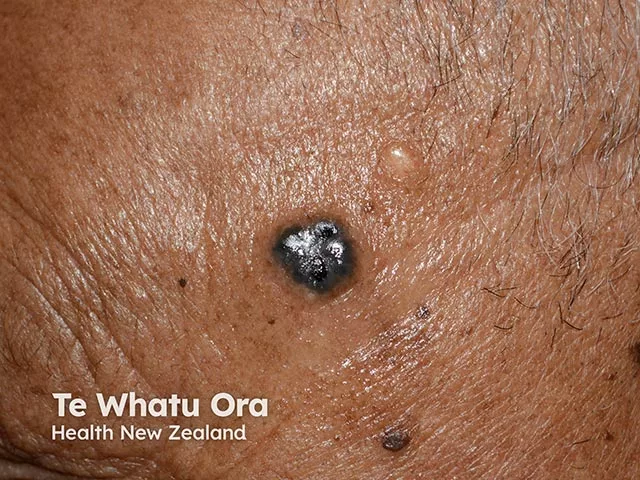
By stage 2, basal cell carcinoma may be a larger, thickened bump or growth that may crust or ooze. (CC BY-NC-ND 4.0/DermNet)
Some advanced crusty BCCs may be mistaken for a wound or infection. Others can resemble harmless skin growths. Pigmented BCCs may sometimes be mistaken for melanoma because of their darker color.
What It Feels Like
Symptoms may become more noticeable at stage 2 and can include:
- Pain or soreness
- Frequent bleeding
- Burning or itching
- Skin breakdown
- Increased sensitivity
Risks and Complications
Large BCCs are more common in people who delayed seeking medical care, had limited access to healthcare, or didn’t recognize early warning signs. The tumors may also develop in areas that are harder to see, such as the scalp or back.
BCC rarely spreads to distant organs. However, if left untreated, larger tumors can destroy nearby tissue. They may grow into cartilage, muscle, or nearby nerves, which can lead to additional complications.
Treatment Options
Common treatments for stage 2 BCC include:
- Mohs surgery
- Wide surgical excision (removal of the tumor along with a margin of healthy tissue)
- Radiation therapy
Stage 3 Basal Cell Carcinoma
Stage 3 BCC is considered locally advanced. The tumor may be larger than 1.6 inches (4 centimeters) or may have spread into nearby areas, including the nerves, bones, or fat beneath the skin.
BCC may also be classified as stage 3 if it has spread to a nearby lymph node, even if it is smaller than 4 centimeters.
If left untreated, BCC can continue to grow and may progress to stage 4, but this is very rare.
What It Looks Like
Stage 3 lesions are more serious and can damage nearby tissue. They may appear as:
- Deep open sores
- Large ulcerated masses
- Crusted or bleeding tumors
- Thick, scarlike areas
- Growths that change the shape of nearby facial features
- Areas of blackened or dead tissue
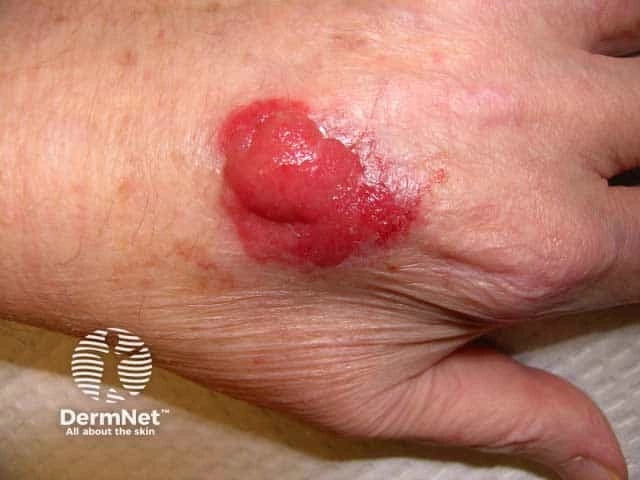
Stage 3 basal cell carcinoma appears as open sores or ulcers, thick scarlike patches, or tumors that bleed or crust over. (CC BY-NC-ND 4.0/DermNet)
How It Feels
Stage 3 BCC may affect normal movement or sensation depending on where it develops. For example, a tumor near the eye may affect vision. Tumors that grow into nerves can cause numbness or pain. Other symptoms can include:
- Significant pain
- Persistent bleeding
- Foul-smelling drainage
- Swelling
- Difficulty moving a nearby body part
- Numbness or tingling
BCC isn’t likely to spread to distant areas, but locally advanced BCC can still cause serious complications. Tumors on the face can be especially challenging because they may damage the nose, ears, lips, or eyes. Changes in appearance may also affect a person’s confidence or emotional well-being.
At stage 3, BCC can look like a deep open sore or an angry mass, which may be crusted and bleeding. Some areas may look thick and scarlike or have blackened tissue.
Treatment Options
At this stage, BCC becomes harder to treat. Surgery may be more extensive, and some people may need reconstructive surgery. Stage 3 tumors are often treated with a combination of therapies, including:
- Extensive surgery
- Mohs surgery, when appropriate
- Radiation therapy
- Targeted medications such as hedgehog pathway inhibitors
Depending on the tumor’s location and the amount of tissue removed, reconstructive surgery may be needed after treatment.
Stage 4 Basal Cell Carcinoma
Stage 4 BCC is very rare. At this stage, the cancer has spread to distant parts of the body. It may affect the bones, distant lymph nodes, or the lungs.
What It Looks Like
The original skin lesion is often very large and may cause extensive damage to nearby tissue. The primary tumor may appear as:
- A severely ulcerated wound
- A lesion that bleeds repeatedly
- A deep ulcer that may look infected
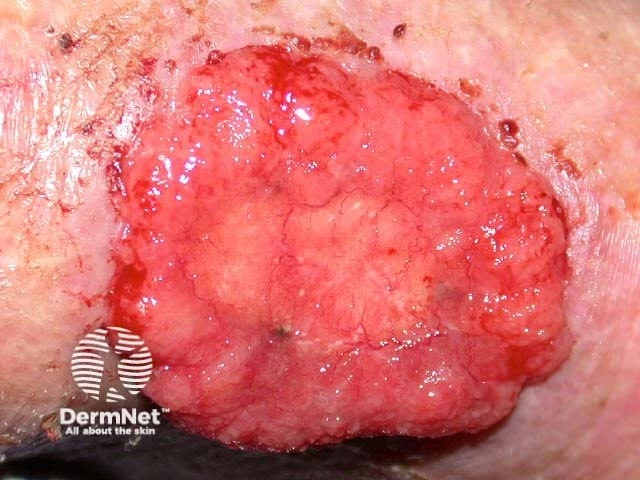
At stage 4, basal cell carcinoma may appear as a large ulcer that bleeds and may look infected. (CC BY-NC-ND 4.0/DermNet)
What It Feels Like
Symptoms of metastatic cancer depend on the areas affected and may include:
- Fatigue
- Headaches or seizures
- Swollen lymph nodes
- Bone pain or fractures
- Shortness of breath (if the lungs are affected)
- A swollen belly or jaundice (yellowing of the skin and eyes)
- Unexplained weight loss
Treatment Options
Treatment at this stage focuses on controlling the cancer and easing symptoms. Treatment options may include:
- Radiation therapy
- Surgery
- Supportive and palliative care
Some people also respond well to newer targeted therapies and immunotherapy drugs.
Join the Conversation
On MySkinCancerTeam, people share their experiences with skin cancer, get advice, and find support from others who understand.
What symptoms of BCC did you have when you were diagnosed? Let others know in the comments below.
- Basal Cell Carcinoma Stages — Moffitt Cancer Center
- Basal Cell Carcinoma — Dermatology of Central Ohio
- Basal Cell Carcinoma — StatPearls
- Stages and Grades of Skin Cancer— Cancer Research UK
- Basal Cell Carcinoma: From Symptoms to Treatments — American Academy of Dermatology
- Basal Cell Carcinoma — Mayo Clinic
- Advanced Basal Cell Carcinoma in a Geriatric Patient: A Case Report and Ethical Considerations — Cureus
- Metastatic Cancer: When Cancer Spreads — National Cancer Institute
Related
- What does basal cell carcinoma look like? See answer
- Is basal cell carcinoma hereditary? See answer
- How can I tell the difference between a mole and skin cancer? See answer
- What's the life expectancy with nonmelanoma skin cancer? See answer





 Your Privacy Choices